





 |
Newsletter
|
Donate
|
Newsletter
|
Donate

MYTH BUSTER: European Health Care Models
Posted: July 23, 2026
(July 22, 2026)
Pro-privatization groups, some of which are funded by or linked to right-wing American organizations and corporate interests, have turned to making false claims about two-tier European health care systems in their push to privatize our Canadian public health care. This tactic is an attempt to divert attention from the American health care system that the Canadian public generally knows more about and understands to be a failure. Nonetheless, Canadians are often subject to myths about the United States also, particularly about wait times and costs. This myth buster addresses the most common of privateers’ claims, starting with clear information about the United States, then looking at their claims about Canadian public health care compared to Europe and Australia.
United States: Almost double our costs, yet they don’t get the coverage…and, yes, Americans do face lots of wait times
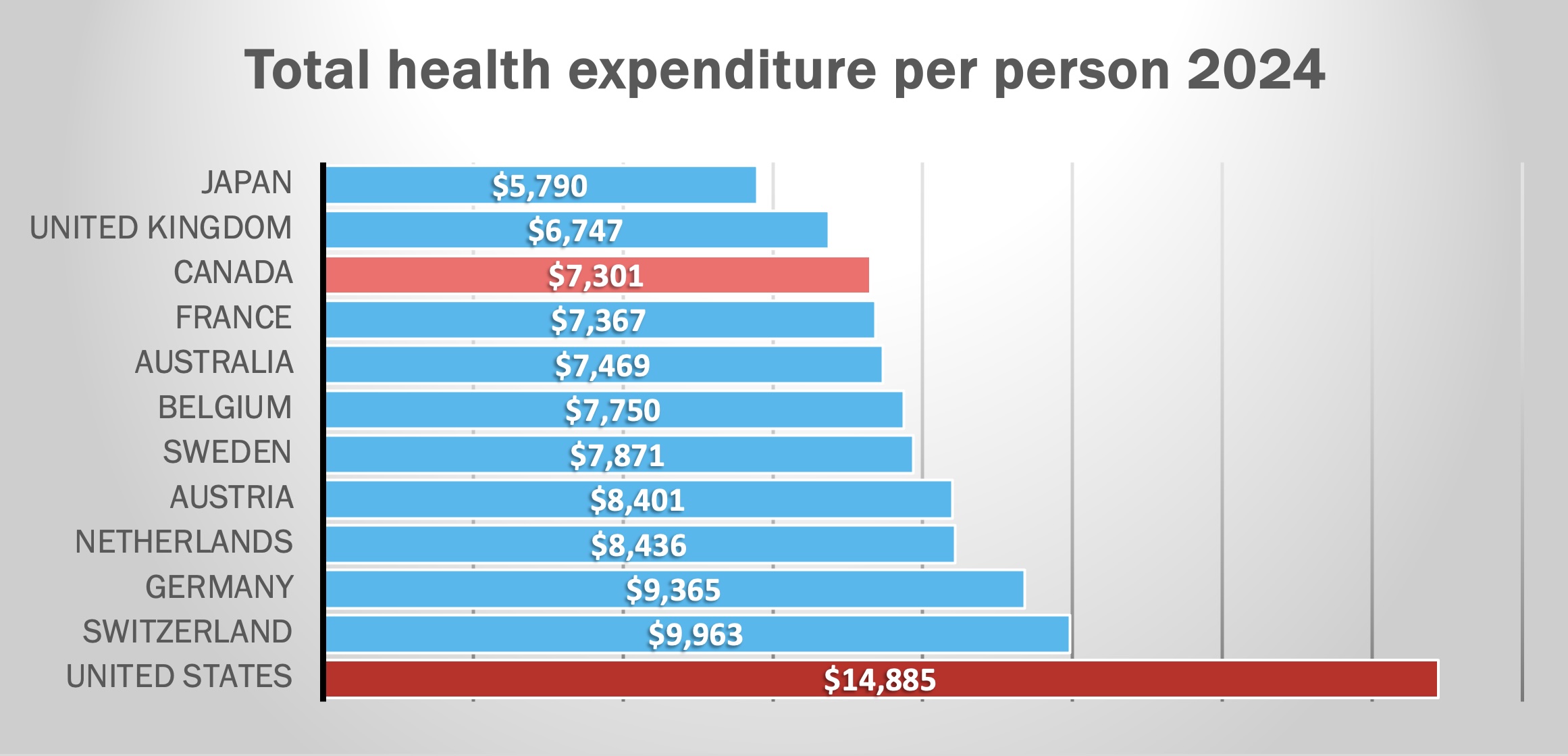
The United States has the most privatized health care in the developed world. Americans pay more than double what Canadians pay for health care.
U.S. for-profit hospitals charge exorbitant prices. Businesses face high insurance costs for employees. On top, employees pay co-payments every paycheque plus they have to pay deductibles before coverage kicks in…IF they are covered. Insurance companies make profits by denying coverage.
Medical costs are the top reason for bankruptcy. 56 million Americans struggle with medical debt: more than Canada’s entire population.
Let’s look at wait times
The United States doesn’t have a public health system that covers its population like we do. Except for services for veterans, Medicare for seniors and Medicaid for the poor, which are being cut, they mostly have private insurance plans bought by their workplaces. There are no publicly available central tracking sources for wait times in the U.S. system, in part because there is no actual “system”. However, there is a lot of reporting about wait times.
Americans have to wait for approvals or denials from insurance companies to find out whether the treatment, diagnostic test or surgery they need is covered. These can take a long time, and denials mean that patients have to appeal or they go without. In addition, Americans have to wait for appointments, just like everyone else does.
For example, a 2022 survey of physician offices showed that the average wait time to see a family doctor in urban areas was three weeks. The average wait time to see a cardiologist was close to four weeks. In rural areas, the situation is worse. One resident of rural Vermont spent six months looking for a family doctor and the closest he got to booking an appointment was being put on an “indefinite wait list.” Even in a large urban setting such as Los Angeles, a physician is currently reporting that his patients with serious acute health care needs such as congestive heart failure are waiting on stretchers in emergency for two days for an inpatient hospital bed.
The myth of the successful European private health system
The level of health care privatization and structure of health care systems varies drastically across Europe despite privateers’ vague references to “European health care”. There are good things and there are bad things about each of the different systems. Generally speaking, the groups pushing for privatization have chosen health systems that allow private health insurance companies, user fees and co-payments for patients on top of public health insurance, and for-profit delivery of care. They have cherry-picked statistics, or entirely misreported the data to support their claims. For example, their claim that Germany or Switzerland, for instance, have lower costs is just completely false. So too is the claim that there are no waits for care.
Germany
Germany has some of the highest administration costs among OECD countries, just behind Switzerland and the United States, because of its complex fragmented health care system. Its mandatory health care insurance plan is mainly funded by payroll taxes and provided by around 100 private insurers, each of which incurs their own administration and overhead costs. In Germany, a small tier of high-income earners buy private insurance. This drains financial resources from the public mandatory system while private insurers could face a €12 billion shortfall by 2027. There are complaints about this privileged elite getting faster access to care. The evidence from a study comparing the wealthier patients who bought supplemental private insurance to the rest of the population shows that there are indeed wait times for the general population. E.g., for an eye exam, the wait was just over a month and there was a longer wait — 70 days — for a pulmonary function test. People wait months to see specialists while wait times have hardly improved since 2019. But while the general population waits, privately insured patients are over-treated with unnecessary X-rays and MRIs because private insurance companies pay doctors more than mandatory insurance.
In addition, a growing number of people with private insurance are struggling with increasing premiums and even falling into debt, particularly those who are self-employed, low-income civil servants, and the elderly. At the same time, private insurance companies deny treatment to elderly patients because of their age. If people switch to less expensive basic plans, they are disadvantaged. “Doctors only treat patients with basic insurance for a higher fee” because they cannot charge them multiple times the standard rate as they do with regular private patients. People then have to fight their insurance companies to get coverage. One German patient was a firm believer in private health insurance when he was still healthy and earning a good living. Now at 65 years old and in need of cataract surgery, he wishes he were back in the public system, saying, “Hindsight is always 20/20.” His private insurance company refused to cover his surgery, so he ended up needing to borrow money to get care.
There is also an increasing problem of people losing coverage because they lose their jobs. Anywhere from half a million to a million people do not have coverage at all because they are unhoused or cannot find jobs that offer insurance. A volunteer doctor at a clinic that serves people without health insurance says, “We see this often. People come in with untreated illnesses because they simply had no way to see a doctor or if they could, it would have cost them far too much.”
Repositioning privatization to make it more palatable for Canadians
Because polling shows that the majority of Canadians support public health care, oppose privatization, and want our health care to be non-profit, pro-privatization forces have had to shift their sales pitch. The push to promote European health systems as a way to push for privatization comes from this.
In November 2005, Dr. Brian Day, then head of the largest private for-profit hospital in Canada and the president of the CMA, held a “Saving Medicare Summit” in Vancouver.* The conference openly advocated full two-tier medicare. At this conference, Preston Manning, founder of the Reform Party, recommended that the delegates:
Present their ideas as a “compromise”: Canadians love compromise. Re-define two-tier medicare as between the status quo and the U.S. private system. Make the extreme seem moderate. Start where there is vulnerability, such as Quebec.
“Once the battle over language has been won,” Manning said, “it will be politically easier to follow is substantive prescription: completely dismantle national Medicare, have the federal government hand over more taxing power to the provinces and let them handle Medicare as they please.”
*Brian Day went on to lead a legal challenge to bring down our public medicare laws, starting in British Columbia. He ultimately lost in court.
Switzerland
The Swiss also pay far more for health care than we do. Their high administration costs are attributed to a decentralized and mixed for-profit health care system where 26 cantons (states) govern health care. Residents are required to purchase health insurance from private insurers, and financial barriers to care for low- and middle-income households are worsening because premiums are rising and government subsidies have been cut. Physician shortages have led to the Association of Swiss General Practitioners and Paediatricians warning the public that wait times to see a family doctor would be several months long and that they would need to turn away patients with minor illnesses, risking late diagnoses for diseases like cancer.
Australia
Australia had single-payer health care like Canada until a two-tier system was introduced in 1999 with the goal of reducing wait times. However, when private health care was introduced, wait times in the public system got worse. The government has reported nearly four-year average waits to get specialist appointments and even waits lasting years. Rising premiums and inadequate coverage from private health insurance have now led to calls for the system’s reform back to a single-payer system. In 2023, Australia’s Health Minister admitted that health care was “in the worst shape it [had] been in its 40-year-history” as public funding cuts led to more family doctors charging patients out-of-pocket instead of billing the public health care plan. An increasing number are skipping or delaying doctor’s appointments because they cannot afford them. The majority of Australians do not choose to purchase private insurance because of increasing premiums and 65% of policies don’t cover all services. And, in the past 25 years, the premiums have increased 60% more than wages in Australia have done. In addition, the company that operates 37 private hospitals in Australia was placed into receivership after being bought out by Brookfield, a private equity firm based in Toronto, further proving that the private part of their two-tier system is failing.
France
France has a two-tier health system where most people need to purchase private insurance to reduce out-of-pocket payments because public coverage is not robust enough. According to the World Health Organization, the most vulnerable patients are more likely to pay more out-of-pocket for care.
France is often cited (falsely) both as not having wait times and as being cheaper. In parts of the country, cardiologist wait times are 24 weeks (more than five months) long on average. French people forego procedures because of long wait times and the cost of care while expressing anger about the “lack of resources allocated to public hospitals and the working conditions of healthcare staff”. The French actually pay more for health care than do Canadians because they need to manage a mix public and private insurance.
A closer look shows that copying France would be devastating here in Canada. According to the most recent data available (2020), doctors in France are paid less than €100,000 (less than CAN$160,838) per year. At the same time, family doctors in Canada earned $287,000 per year and specialists in Canada earn more than double the French – $370,000 per year for medical specialists and $497,000 per year for surgical specialists. It would be disastrous to apply the European wages in Canada which operates in the North American labour market for physicians, far different than Europe’s. In 2024, France even cut 1,510 openings for junior doctors in training while their health care system was strained from poor working conditions made worse by the COVID-19 pandemic.
Scotland vs. England Case Study
Private clinics didn’t work in England to reduce wait lists.
Scotland opted to increase public capacity and refused to privatize
….and it worked.
England has significantly cut public hospital capacity. Instead of adequately funding public hospitals, the government contracted surgeries to private hospitals. The result? They did not reduce wait lists. In fact, waiting times rose for all patients and inequality increased with the poorest 20% of patients – who are more likely to need care – waiting longer than the richest 20%.
Not only did they not solve wait lists, but costs are much higher and yet they take only the light, easy, profitable case load. Overall, surgeries done in the private sector were marked up by 40% in total: government officials admitted that one year’s costs of £100 million in surgeries in private clinics would have cost £70 million if done in the public health system. In one example, coronary bypass surgery in the private sector was twice as much as the public cost.
Private hospitals in England also engage in cherry-picking (or cream-skimming) by accepting only patients with the least medically complex cases to avoid high treatment costs and increase profits. They received just 6% of elective admissions, leaving understaffed public hospitals with “the other 94% of elective work – as well as 100% of the emergencies, complex and chronic care.” Cherry-picking is also seen in private hospitals in Australia.
Private hospitals need staff to operate, so they drain the finite pool of medical staff who are often trained and employed in publicly-funded facilities, exacerbating the health care worker shortage. The combination of less complex patients and higher wages in the private system also incentivizes health care workers to leave the public system. This exacerbates backlogs and decreases the quality of care. For example, England moved 10% of elective surgeries into the private sector, siphoning staff away from the public system and increasing wait times.
On the other hand, Scotland successfully reduced their elective surgery backlog — without relying on private facilities — by adding operating rooms to increase capacity in their public system. The government’s centrally coordinated efforts made it possible to increase surgical efficiency in the public system.
Canada neither has the highest taxes for health care, nor the highest taxes overall. Nor do we spend more than other peer nations on health care.
According to the Organization for Economic Cooperation and Development (OECD), Canada funds its public health care at a much lower rate than the European countries to which pro-privatization groups often compare us. Public health care funding per capita in Canada in 2025 was 36% lower than Germany, trailed France by 14%, and was lower than Switzerland by 24%. Bottom line: Canadians do not pay more for health care, we do not have the highest taxes for health care, nor do we have the highest taxes in general. Those claims are simply not true.
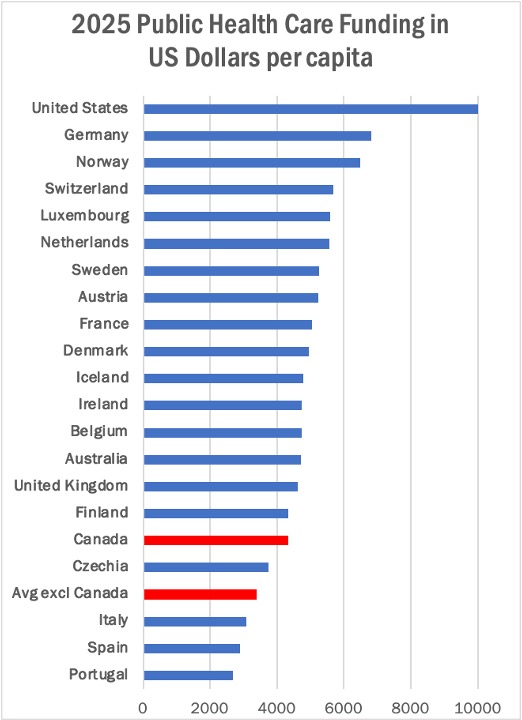
Government/compulsory health spending in US dollars per capita in 2025 among some European countries, Australia, and the United States. https://data-viewer.oecd.org/?chartId=af50bb23-9eec-447b-951f-732167d1f6fd
The Commonwealth Fund
The Canadian Institute for Health Information (CIHI), a crown corporation that provides Canadian health systems data, evaluated Canada’s results from the Commonwealth Fund International Health Survey which assesses the health care systems of eleven countries. Pro-privatization groups have misused data from these reports to push privatization. However, Canada performed better in many areas covered by public health care and worse in areas that are privatized. For this reason, the results support the case for more public health care, not more privatization.
- Compared to the other countries, Canadians were less likely to avoid physician care due to cost. Public Medicare covers medically necessary physician care. However, Canadians reported cost barriers to accessing services that need more public health coverage such as dental care and prescription drugs.
- Canada has some of the fewest hospital beds per population of all OECD countries because of the downsizing of public hospitals. CIHI did not report these cuts, but they have undoubtedly led to Canadians being the least likely to receive care within four hours at emergency departments and wait less than four months for elective surgeries.
A Final Note
It is also important to note that the pro-privatization forces (usually funded by for-profit health care entities and interest groups) often mislead Canadians about our standing in the world. International studies are often misquoted or manipulatively quoted and groups pushing privatization put out information that is sometimes completely false. Prior to the pandemic, the data shows that Canada had the lowest wait times for cataract surgeries and second lowest for joint replacement surgeries among peer nations.